A modern consumer expects more from a kettle than simply boiling water. When someone sets a kettle to 85°C for green tea, they expect it to stop accurately, hold that temperature steadily, and avoid overshooting or repeated reheating. Delivering this kind of experience depends heavily on the control system hidden inside the appliance. At the heart of that system is the 5-Pole Electric Kettle Thermostat, a component that enables smart kettles to move beyond basic on-off heating and into precise, digitally managed temperature control. As a professional thermostat supplier with decades of manufacturing experience, Jiatai has worked closely with appliance brands to support this shift from simple boiling to intelligent heating.
What Makes a Kettle “Smart” from a Control Perspective
Closed-loop temperature control versus simple boil cut-off
Traditional kettles operate on a simple principle. Power flows to the heating element until a physical condition is met, usually steam generation or a temperature threshold, and then the thermostat cuts power. This is an open-loop process. The kettle does not continuously monitor water temperature; it only reacts when a limit is reached.
Smart kettles operate differently. They rely on closed-loop control, where temperature is continuously monitored, compared against a target value, and adjusted in real time. Instead of a single shut-off action, the system constantly balances heating input to maintain a stable setpoint. This difference in control philosophy is the foundation of all smart kettle features.
The feature stack consumers care about
From the user’s point of view, smart functionality is defined by consistency and predictability. Preset temperature options allow different beverages to be prepared correctly. Keep-warm functions maintain water at a stable temperature for extended periods. Repeatability ensures that the kettle behaves the same way every time it is used. All of these features depend on accurate sensing and responsive control, which go far beyond what a basic mechanical thermostat can support.
The Two Extra Poles as a Hidden Enabler
Additional connections for data and low-power functions
A key structural difference between traditional and smart kettle controls lies in pole count. A 3-pole thermostat is generally sufficient to manage the main heating circuit and basic safety functions. A 5-pole design, however, introduces two additional electrical paths. These extra connections are not intended to carry high heating currents. Instead, they are typically used for low-power supply, signal transmission, or coordination with electronic control modules.
In smart kettle architectures, these additional poles provide the communication channels needed to link sensors, indicators, and control logic. Without them, the thermostat becomes isolated from the rest of the system, limiting what the kettle can do.
Separating high-power heating from low-power logic
One of the challenges in smart appliance design is managing high-power heating circuits alongside sensitive low-power electronics. Control boards, sensors, and displays require stable, low-noise electrical paths. A 5-pole electric kettle thermostat allows designers to separate these domains more clearly. High-current switching remains isolated, while low-power circuits can operate reliably without interference. This separation improves system stability and makes advanced control strategies practical in everyday consumer products.
Real-Time Temperature Feedback and the Role of NTC Sensing
How an NTC thermistor works in simple terms
Real-time temperature feedback is essential for smart kettles, and one of the most common sensing elements used is the NTC thermistor. Its operating principle is straightforward. As temperature increases, the electrical resistance of the thermistor decreases. The control system measures this resistance change and converts it into an accurate temperature value. This continuous stream of data allows the kettle to respond dynamically rather than relying on a single mechanical event.
Integrating sensing into kettle control architectures
In a smart kettle, the sensor signal flows through a defined path. The sensing circuit detects temperature changes, the control circuit interprets this information, and the heating circuit adjusts power accordingly. This chain must function smoothly to maintain accuracy. A 5-pole thermostat provides the necessary connections to integrate the sensing path directly into the control system. Without these connections, the feedback loop breaks down, and precise temperature management becomes impossible.
In many advanced designs, temperature sensing is not an add-on but an integral part of the thermostat assembly. This integration simplifies wiring, improves reliability, and supports consistent performance over the kettle’s service life.
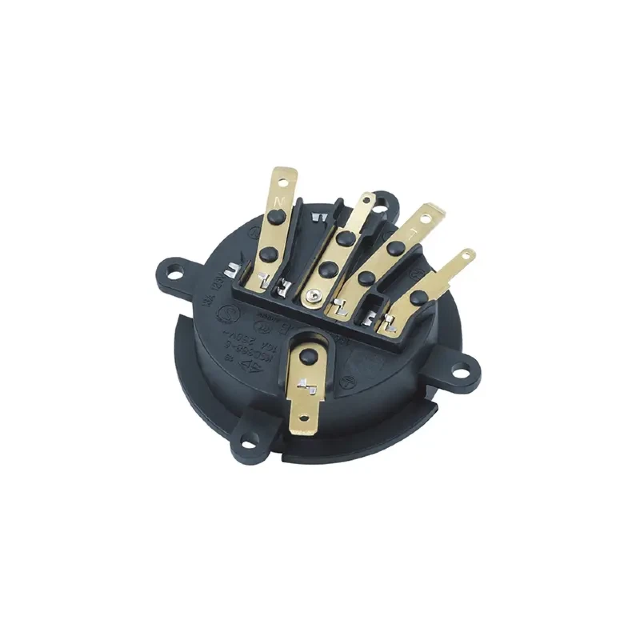
A Practical Example: 5-Pole Coupler with Integrated Sensing and Protection
What integrated design means in real products
In practical applications, a 5-pole thermostat assembly may combine multiple functions within a single unit. Alongside the main switching contacts, it can include embedded temperature sensing elements and protective components such as thermal fuses. This integrated approach allows the thermostat to act as both a control interface and a safety safeguard.
Jiatai develops 5-pole thermostat solutions designed with this integration in mind. By bringing sensing, switching, and protection together, these assemblies reduce system complexity while maintaining precise control.
Benefits for product development teams
For product teams, integrated 5-pole designs offer clear advantages. Development cycles become shorter because fewer separate components need to be qualified and assembled. Safety architecture becomes easier to define, as protective elements are built into the control system rather than added externally. Most importantly, feature performance becomes more consistent across production batches, supporting brand reliability in the market.
What Can Go Wrong Without the Right 5-Pole Design
Control instability and inaccurate keep-warm behavior
When smart kettle features are implemented without proper feedback paths, performance issues quickly appear. The kettle may cycle heating on and off too aggressively, overshoot target temperatures, or struggle to maintain a stable keep-warm state. These problems are not always obvious during initial testing but become apparent in daily use. Users experience inconsistent results, which undermines confidence in the product.
Reliability and lifecycle considerations
Beyond immediate performance, control architecture affects long-term reliability. Reputable control systems are designed to handle repeated thermal cycling, electrical stress, and user variability. A properly designed 5-pole thermostat supports this durability by ensuring that sensing and control remain accurate throughout the product’s lifecycle. When shortcuts are taken, wear and drift can compromise both safety and functionality over time.
Architecture Snapshot: Smart Kettle Functions and Required Connections
Smart Function | What the Controller Needs | Why a 5-Pole Design Helps | Typical Components Involved |
Preset temperatures | Continuous temperature feedback | Extra poles support sensor signals | NTC thermistor |
Keep-warm mode | Stable low-power control loop | Dedicated low-power paths | Control board interface |
Temperature display | Real-time data transmission | Separate signal connections | Sensor and display logic |
Safety cutoff | Redundant protection paths | Integrated protection circuits | Thermal fuse elements |
This conceptual overview highlights how smart features depend on structured signal and power pathways. The additional poles are not optional extras but functional necessities for advanced control.
Where Jiatai Fits in the Smart Kettle Supply Chain
Thermostat-focused manufacturing background
Jiatai, officially known as Zhejiang Jiatai Electrical Appliance Manufacturing Co., Ltd., was founded in 1985 and has grown into a specialized manufacturer focused on thermostat design, development, and production. With hundreds of employees, dedicated research teams, and advanced testing facilities, Jiatai concentrates on delivering reliable thermal control solutions for a wide range of heating appliances. The expansion of its manufacturing facilities reflects a long-term commitment to supporting growing customer demand with consistent quality.
Selecting within a product family without changing the brand platform
Many appliance brands aim to maintain a unified product platform while offering different feature levels. This is where a structured thermostat product family becomes valuable. Boil-only kettles can continue using simpler control solutions, while smart and feature-rich models adopt 5-pole designs. Jiatai supports this strategy by offering both 3-pole and 5-pole thermostat options within a cohesive product range. This allows brands to scale features without redesigning their entire appliance architecture.
Conclusion
Smart kettles are defined by their ability to control temperature precisely, respond intelligently to user input, and maintain stable performance over time. These capabilities rely on feedback, low-power signal paths, and integrated safety logic, all of which are enabled by a 5-pole control structure. This is why smart kettle designs consistently depend on the 5-Pole Electric Kettle Thermostat as a core component of their architecture. As a dedicated thermostat supplier, Jiatai works closely with appliance brands to translate feature requirements into reliable control solutions. If you are developing or upgrading smart kettle products and need a control solution that supports advanced functionality, contact us to discuss your application and explore a matching smart kettle thermostat configuration tailored to your needs.
FAQ
Q1: Why can’t a standard thermostat support smart kettle functions?
Standard thermostats typically lack the extra connections needed for real-time sensing and digital control, limiting them to simple boil cut-off behavior.
Q2: Are all smart kettles required to use 5-pole thermostat designs?
Most smart kettles rely on 5-pole designs because they need additional signal and low-power paths to support advanced features.
Q3: How does temperature sensing improve user experience?
Continuous temperature feedback allows the kettle to stop accurately at target temperatures and maintain stable keep-warm performance.
Q4: How does Jiatai support smart kettle development?
Jiatai provides integrated 5-pole thermostat solutions designed to support sensing, control, and safety requirements for modern smart kettles.